
Braun Food Factory
Showing all 2 results
-
Braun Food Factory, Food Factory, Kitchen Appliances
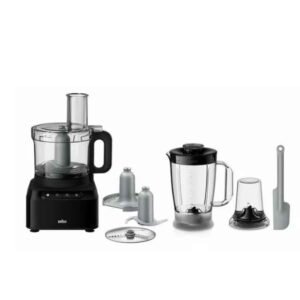
Braun Food Factory 3132
0 out of 5(0)- Speed settings: 2 speed buttons
- Watt (W):800
- Cord storage: Yes
- Dishwasher safe parts: Yes
- BPA free food contact parts: Yes
- Dough/kneading tool: Yes
- Whipping/blending tool: Yes
- Blender attachment 1.2 l: Yes
- Plastic food processor bowl 2.1 l: Yes
- Reversible stainless steel 4mm slicing/shredding disc: Yes
- Emulsifying disc: Yes
- Multi mill: Yes
- Spatula: Yes
SKU: n/a -
Braun Food Factory, Food Factory, Kitchen Appliances
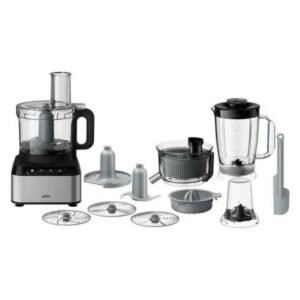
Braun Food Factory 3235
0 out of 5(0)- Speed settings: 2 Speeds & Pulse
- Pulse button: Yes
- Wattage: 800
- Cord storage: Yes
- Dishwasher safe parts: Yes
- BPA free food contact parts: Yes
- Citrus juicer: Yes
- Juice extractor: Yes
- Dough/kneading tool: Yes
- Blender attachment 1.2 l: Yes
- Plastic food processor bowl 2.1 l: Yes
- Reversible stainless steel 4mm slicing/shredding disc: Yes
- Reversible stainless steel 2mm slicing/shredding disc: Yes
- Rasping/parmesan disc: Yes
- Emulsifying disc: Yes
SKU: n/a
Showing all 2 results
Braun Food Factory in Pakistan — Compare Models, Attachments & Latest Prices
If you’re shopping for an original Braun Food Factory in Pakistan, this category guide helps you decide quickly and confidently. We focus on what matters in real kitchens: how much power you actually need, which attachments make daily Pakistani cooking faster, and how to compare prices without guesswork. Because model bundles and availability can change, always rely on the live product cards on our website for the latest price and in‑the‑box accessories before you place an order.
Quick Picks (for fast decisions)
Best for Everyday Desi Cooking
Choose a compact Braun Food Factory in the 600–800W range if your priority is routine prep: slicing onions, shredding salads, chopping tomatoes, making raita or chutneys, and grinding small spice mixes. These models are easy to store, straightforward to clean, and typically come with the core slicing/shredding discs that most kitchens use daily.
Best for Family Meal Prep
Go for a ~2.0–2.1L bowl class with a blender jug if you often batch‑prep gravies, pasta sauces, and smoothie mixes for 3–6 people. You’ll appreciate a wider feed tube, an emulsifying tool for creams and dressings, and reversible discs to quickly switch between fine and coarse results. If you host daawats, the extra capacity saves time across multiple dishes.
Best for Dough & Heavy Duty
If you’re kneading dough regularly or tackling tougher tasks, consider the higher‑power end (up to ≈1000W). You’ll want a dedicated dough tool, strong motor housing, and a solid interlock system. This tier gives you more headroom for kneading roti/paratha dough, shredding harder vegetables, and running multiple batches back‑to‑back.
Shop by Model & Power
Below is a people‑first guide to Braun’s common model classes in Pakistan. Exact features, wattage, and attachments differ by SKU and batch; the product page is always the source of truth. Compare by wattage + bowl size + attachment bundle rather than by marketing names like “8‑in‑1” or “9‑in‑1”.
Popular Braun Food Factory Models in Pakistan
Core family (≈2.0–2.1L class, ~800W): Great all‑rounders for homes. Typical highlights include a 2‑speed + pulse interface, dishwasher‑safe parts (check model), and BPA‑free food contact parts (check model). Expect a reversible slicing/shredding disc set, a chopping blade, an emulsifying tool, and often a blender jug; some bundles include a mill/chopper, citrus juicer, or additional discs. These are ideal for families who want the most‑used functions covered without overpaying for specialized accessories they won’t use.
Higher‑power options (up to ≈1000W): Prioritize these if you want extra margin for kneading or frequent, heavy prep. You may see more disc options (e.g., finer/coarser shredding, rasping) and sturdier overall construction. The trade‑off is price: higher wattage plus richer bundles usually costs more. If your daily routine truly needs the power—go for it; otherwise, an 800W class may be perfect value.
Legacy/interest models (e.g., FP3020, FX3030): Often referenced in buyer research and forums. Availability in Pakistan can vary; features and attachments also differ by region. Treat these as reference points for understanding Braun’s design language and feature tiers rather than fixed benchmarks for what ships here today.
Shop by Wattage (What it actually changes)
600W — compact routine prep: Light slicing/shredding, simple chopping, small spice grinding (with a suitable mill/chopper), and basic purees. If you cook for 1–3 people and don’t knead dough daily, this is usually enough. You’ll enjoy lower energy draw and easier handling.
800W — the sweet spot for families: Balanced power for households that do everything: grate harder veggies, slice potatoes, prep kheer toppings, make smooth purees, and run a blender jug for shakes. If you’re unsure, start here—it tends to deliver the best value‑for‑money and accessory coverage for Pakistani families.
≈1000W — for dough and heavy loads: If your must‑have is consistently good dough or frequent large batches, higher wattage gives stability and speed. You’re paying for motor headroom and durability under stress. Make sure your bundle includes a proper dough tool and that the bowl capacity suits batch sizes you actually make.
How to match power & capacity to your household
- Students/hostels (1–2 people): 600–800W, compact bowl, keep accessories minimal. You’ll still slice/shred faster than by hand and save space.
- Couples/small families (2–4 people): 800W with ~2.0–2.1L bowl and blender jug. Versatile mix of power and capacity for daily use.
- Large families/meal‑preppers: 800–1000W with generous discs and a dedicated dough tool. Consider extra bowls or a mill if you grind spices often.
What to ignore (so you don’t overpay)
- “X‑in‑1” counts: They’re often just tallying every disc and tool separately. Focus on the specific tasks you’ll use: slicing thickness, shredding fineness, dough tool quality, and whether a mill/citrus juicer is included.
- Max claims without context: A 1000W motor is great, but a well‑designed 800W unit with sharp discs and a good dough tool can beat a poorly bundled 1000W for real‑world results.
- Unclear “programs” or “intelligent” modes: Check the product page for the exact model to see what’s actually included and supported—it varies by SKU.
Tip: Before adding to cart, skim the attachments list on the product page. If you need a blender jug and a mill for spices, make sure both are explicitly listed; if not, see if another SKU in the Braun Food Factory category includes them.
What’s in the Box (Attachments Cheat‑Sheet)
Core Attachments Explained (and what to use when)
Blender Jug: Your go‑to for liquids and pourable mixes. Use it for smoothies, milkshakes, lassi, chilled coffee, tomato purée for salan, or blitzing boiled spinach for palak. Unlike the processor bowl, the jug handles thinner consistencies without splashing, and its spout makes pouring clean and quick.
Chopping Blade (S‑blade): The workhorse inside the main bowl. It chops onions, tomatoes, chillies, and herbs; pulses dry fruits; and helps with crumb mixes for cutlets or kababs. For best results with onions (to avoid mush), use short pulses and empty the bowl before it warms from friction.
Reversible Slicing/Shredding Discs: Two jobs per disc—flip for a different cut. The “thin” side is great for cucumber, radish, or cabbage salads, and potato chips; the “coarse” side handles carrot for kheer or coleslaw, shredded cheese, and firm vegetables. If your bundle includes multiple discs (e.g., 2 mm and 4 mm), select based on how delicate you want the cut to look and cook.
Emulsifying Tool: Think creams and airy textures. Whip fresh cream, emulsify mayonnaise, or make quick dressings for salad. It’s also handy for batters (pancake, fritter) that benefit from air incorporation without overworking the mix.
Dough Tool: Designed to bring dough together without turning it sticky. For roti/paratha, start on low speed until the dough forms a ball, then rest the dough outside the bowl. For pastry or namak para, short pulses prevent gluten overdevelopment.
Citrus Juicer: Ideal for kinnow, oranges, and lemons. The reamer extracts juice efficiently without pulverizing the pith. If your model ships with both small and large reamers, use the smaller one for lemons/limes and the larger for oranges/kinnow.
Mill/Chopper (when included): A smaller jar for dry/wet grinding in small batches—garam masala, roasted cumin, coriander seeds, or chutneys. It’s perfect when you don’t want to wash the big bowl for a handful of spices.
Model‑Dependent Attachments (availability varies by SKU)
Attachment bundles change across models and batches. Some SKUs add a rasping disc for potatoes, extra‑fine slicing for salads, or a French‑fry disc. Others include both a blender jug and a mill, while compact sets skip one or the other. Always treat the product page as the final word: buy the SKU that explicitly lists the tools you need most.
- Need dough weekly? Prioritize a bundle with a dedicated dough tool and generous bowl size.
- Make smoothies daily? Ensure a blender jug is listed; a processor bowl alone is not a smoothie replacement.
- Grind spices often? Look for a mill/chopper in the box; buying it separately later can offset any “savings.”
- Juice frequently? Confirm a citrus juicer attachment; some sets do not include it by default.
“8‑in‑1” vs “9‑in‑1”: what the numbers actually mean
Those counts tally functions or parts rather than meaningful kitchen tasks. A “9‑in‑1” might simply add an extra disc or reamer. Instead of chasing the highest number, map your top 5 tasks (e.g., slice, shred, puree, dough, mill) to the attachments explicitly listed on the SKU. This prevents overpaying for parts you’ll rarely touch.
Disc Selection 101 (cut quality & speed)
Thin slice (≈2 mm): Uniform stir‑fry veggies, onion for biryani, cucumber ribbons for salads. Cooks faster and looks refined on the plate.
Thick slice (≈4 mm): Potato slices for air‑fryers, sturdier salad prep, and veggies that shouldn’t go limp.
Fine shred: Carrot for halwa or kheer, cheese that melts evenly, slaw that feels light.
Coarse shred: Achar prep, pizza toppings, or any shred that should hold bite after cooking.
Keep blades/discs sharp, avoid forcing oversized produce through the feed tube, and let the disc do the work—pushing hard produces uneven cuts and strains the motor.
Assembly Basics (quick correctness check)
Food processors rely on interlocks: the bowl must seat fully, the lid must lock, and the pusher should be correctly placed for the motor to engage. If the unit won’t start, re‑seat each part carefully. Always start on low speed for new recipes; ramp up only if needed to protect the motor and preserve texture.
Prices in Pakistan — How to Read Them (No Guesswork)
What actually drives the price
- Wattage: More power generally costs more. A well‑designed 800W model can outperform a poorly bundled 1000W for daily tasks—don’t pay for watts you won’t use.
- Attachment bundle: Blender + mill + extra discs add value and cost. Buying the right bundle upfront is usually cheaper than sourcing add‑ons later.
- Bowl size & materials: Larger bowls and higher‑grade plastics/finishes can raise the price. Dishwasher‑friendly parts are convenient; confirm on the product page.
- Series/line: Newer lines sometimes include refined ergonomics, upgraded feed tubes, or added safety features—reflected in pricing.
- Official warranty: Units with official country warranty typically price higher than grey‑channel imports. The extra cost buys peace of mind for parts/service.
- Logistics & seasonality: Exchange rates, duties, and festive/off‑season promos can influence shelf prices and cart totals.
How to check today’s price (and compare smartly)
- Open the Braun Food Factory category on our site and view each product card for the live price and bundle summary.
- Open 2–3 products in new tabs and compare by wattage + attachments + bowl size. Ignore the “X‑in‑1” label; prioritize the jobs you need.
- Use filters (where available) to narrow by wattage (600W / 800W / ≈1000W) and essential tools (blender, mill, citrus juicer).
- Add to cart to see your delivered estimate with city‑specific options (COD/online payment). Timelines and costs can vary by Karachi, Lahore, and Islamabad.
Value framework (avoid overpaying)
- Cost per watt: Compare similar bundles; if a 1000W model adds little beyond raw power, the 800W “sweet spot” may be better value.
- Cost per attachment: If you’ll use the mill daily, paying a bit more for the bundle that includes it can be cheaper than buying separately.
- Cost per job: List your top tasks (dough, slicing, smoothies, spice grind). Choose the model that nails all five without expensive extras you’ll never touch.
Example: If your weekly routine is dough + chutney + smoothie + salad shred, you want: dough tool, mill, blender jug, and at least one reversible slicing/shredding disc. A compact set missing the mill may look cheaper—but once you add a separate mill, you might exceed the price of a richer bundle.
Why prices differ for “same” model names
Model names can span multiple regional SKUs. Two listings that look identical may ship with different discs or accessories. That’s why we always advise checking the exact box contents on the product page and photos. When in doubt, call us—our team can confirm what arrives in the carton before you place the order.
Money‑saving tips (without compromising originality)
- Prioritize bundle fit over headline watts: An 800W with the right tools often saves more time and money than a barebones 1000W.
- Watch for clearly marked promotions: Site banners or product badges may indicate limited‑time offers—avoid relying on off‑site “deal lists.”
- Verify warranty vs. grey imports: If a price looks unusually low, check for official Pakistan warranty, stamped invoice, and serial verification guidance.
- Buy once, buy right: If you grind spices weekly, the built‑in mill pays for itself in time saved and consistent results.
When to step up a tier
If your current unit struggles with kneading or heats up on large prep days, moving from 600–700W to 800–1000W with a better disc set can transform your workflow. If you rarely use smoothies or spices, there’s no need to pay for a blender jug or mill you won’t touch—choose a leaner bundle and spend the difference on quality cookware or storage.
Originality & Warranty in Pakistan
How to verify an original Braun unit (before and after delivery)
When you’re buying a Braun Food Factory in Pakistan, the best safeguard is to verify the product’s origin and documentation at each step. Check the listing for official warranty and match the in‑box accessories to your needs. On delivery, inspect seals, confirm the model code on the carton matches the product label, and examine parts for clean molding and snug fit. Photograph the serial/model sticker and keep it with your stamped invoice—this speeds up any future support requests.
Counterfeits can mimic the look but struggle with the feel: lids that don’t lock smoothly, discs that wobble, inconsistent print quality, or unusually light‑weight parts. If anything seems off, pause setup and contact us immediately. We’ll guide you on verification and next steps before you run the motor.
Warranty coverage & claims flow (Pakistan)
Warranty duration and coverage are set by the manufacturer for your specific SKU. Typically, manufacturing defects are covered; consumables and misuse are excluded. To start a claim, you’ll need your stamped invoice, serial photos, and a clear description of the fault (when it occurs, with which attachment, any error indications). Keep the packaging until you’ve tested the unit for a few days—it makes courier handling safer if service is needed.
If you suspect a defect, stop using the product and note any pattern (e.g., shuts off after heavy load). Call our team and we’ll help you follow the authorized service route for your model. We do not invent or alter manufacturer terms; the product page and in‑box warranty card are the source of truth. If your city is far from a service point, we’ll explain courier‑safe packing and documentation so your claim proceeds smoothly.
Which Braun Food Factory is right for you?
Use‑case scenarios for Pakistan (match routine to machine)
Students/hostels (1–3 people): Choose 600–800W with a compact bowl and the essential slicing/shredding disc. You’ll blitz chutneys, prep salads, and handle basic chopping without occupying half your counter. If smoothies are part of your routine, pick a bundle with a blender jug; if you grind spices weekly, a mill saves time and keeps aromas out of the main bowl.
Families & home chefs (3–6 people): An ~800W, ~2.0–2.1L class is the sweet spot for everyday Pakistani cooking. You’ll slice, shred, puree, knead light‑to‑medium dough, and whip creams efficiently. If you batch‑cook gravies or prep dough frequently, consider stepping up to a higher‑watt model with a dedicated dough tool and sturdier discs so you can run multiple batches back‑to‑back without babying the motor.
Feature‑priority checklist (so you don’t overpay)
Start with the jobs you actually do each week: dough, smoothies, spice grinding, slicing thickness, shredding fineness. Then confirm the attachments that enable those jobs are explicitly listed on the SKU—blender jug, mill/chopper, dough tool, citrus juicer, and the disc sizes you want. Wattage matters, but it’s only one piece of the puzzle; sharp discs and a bowl that fits your batch size often deliver more value day‑to‑day than a higher power rating alone.
Finally, match capacity to household rhythm. If most of your cooking is for two but you host occasionally, an 800W with a good disc set and blender jug is usually perfect. If you knead dough most days or prep for big families, consider ≈1000W with robust interlocks and a strong dough tool. The right choice feels effortless during your busiest cooking days—no stalling, no overheating, consistent textures.
Safety & Maintenance
Safe operation (interlocks, loads, and smart habits)
Food processors rely on bowl‑lid interlocks: the unit won’t start if parts aren’t seated correctly. Always assemble on a dry, level surface; keep the motor base away from water; and never bypass safety features. Begin on low speed to learn how ingredients behave, then pulse or step up as needed. If you hear strain or see the bowl overfilling, stop and split the batch rather than forcing it.
Avoid running hot liquids in the processor bowl and don’t immerse the motor base in water. For dough, add liquids gradually and let the dough tool do the work; “riding” the motor with heavy pressure can cause unnecessary stress. If you notice a burning smell, switch off, unplug, and let the unit cool before resuming with smaller loads or shorter cycles.
Cleaning & care (fast routines that protect parts)
Disassemble immediately after use to prevent stains and odors from setting. Most bowls, lids, and discs on modern models are dishwasher‑friendly on the top rack (confirm on your product page), but hand‑washing with mild detergent extends clarity and sharpness. Use a soft brush for the disc teeth and the bowl’s internal corners; avoid abrasive scouring pads that cloud plastics and dull edges.
For lingering smells (garlic/masala), soak parts briefly in warm water with a little baking soda or white vinegar, then rinse and air‑dry fully before reassembly. Store blades and discs in a dry place; moisture accelerates corrosion on metal parts. Re‑check the gasket and lid seals periodically—clean, intact seals improve performance and reduce leaks.
Longevity tips (keep performance like day one)
Sharp tools are safe tools. If your shreds look mushy or slices tear, the disc may be dull—reduce pressure and consider replacement if needed. Cut oversized produce to fit the feed tube; forcing whole items through stresses the disc and the motor. Give the motor short rests between heavy batches so internal heat can dissipate naturally.
Use the right attachment for the job: a dough tool for kneading, S‑blade for chopping, blender for liquids, mill for spices. Mixing roles (e.g., thick dough with an S‑blade) reduces quality and can harm parts. Keep the product manual handy or download it from the product page for model‑specific do’s and don’ts.
Delivery & Payment (Karachi • Lahore • Islamabad)
Karachi: delivery windows, COD & pickup
For Karachi customers, delivery timelines are typically shortest thanks to proximity to our office at Office No 206, 2nd Floor, Seema Electronics Centre, Abdullah Haroon Road, Saddar, Karachi. Cash on Delivery (COD) and online payment options are shown during checkout; availability can vary by stock status and courier coverage. If you’d like guidance before placing an order, call 0339 2009000 and our team will confirm what’s inside the box for the exact SKU you’re viewing so you can buy with confidence.
Need urgent gifting or same‑day options? Ask our support team to check current possibilities for your neighborhood. We avoid promising timelines that aren’t realistic; your cart and order confirmation reflect the latest estimate based on courier capacity and ready‑to‑ship stock.
Lahore & Islamabad: what to expect
For Lahore and Islamabad, COD and online payment options commonly apply, but the exact mix depends on courier partners and live inventory. Add the item to cart to view city‑specific delivery estimates and costs. If your address is outside main courier routes, our team can suggest the most reliable method based on your area and schedule.
To prevent order delays, ensure your mobile number is reachable and your address includes nearby landmarks. If your order includes multiple items, they may ship together or in separate parcels depending on availability; the checkout page will indicate the most accurate plan.
Returns & support basics (no guesswork)
We keep returns and support straightforward, guided by the manufacturer’s terms and our store policies as shown on the product and checkout pages. Keep your stamped invoice, original packaging, and all accessories together until you’ve tested the unit. If there’s an issue, call 0339 2009000 with your order number; we’ll explain the next step—inspection, courier pickup guidance, or a visit to an authorized service point depending on the case.
We never alter brand warranty; we help you use it. To avoid back‑and‑forth, share photos or short clips that show the issue (e.g., lid not locking, unusual noise). It saves time and helps the service team diagnose correctly. For accessory‑related questions (e.g., “Is the citrus juicer included?”), the product page’s in‑the‑box list is the final reference for your SKU.